
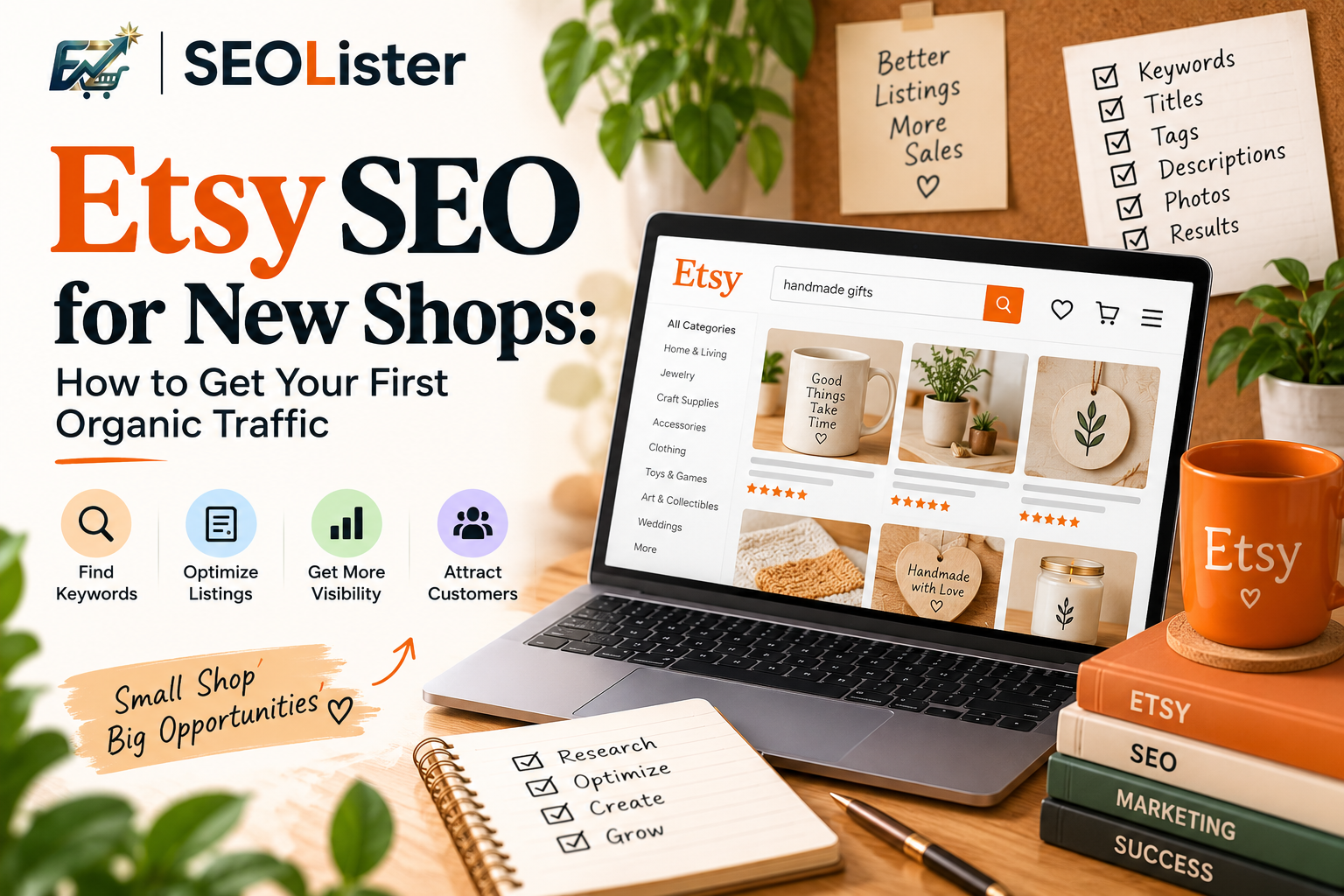
Starting a new Etsy shop is exciting—but getting your first visitors can feel like the hardest part.
You may have great products, attractive photos, and competitive prices, yet your listings still receive very few views.
That’s where Etsy SEO comes in.
Etsy SEO helps your listings appear when shoppers search for products like yours. For a new shop, the goal isn't to rank everywhere immediately. It's to create relevant listings that Etsy can understand, match with searches, and eventually reward with engagement and sales.
In this guide, you'll learn how to build an Etsy SEO foundation that can help your new shop start generating organic traffic.
Can a New Etsy Shop Get Organic Traffic?
Yes.
A new shop doesn't need years of history before it can appear in Etsy search. However, established shops may have advantages from stronger listing engagement, reviews, sales history, and overall shop quality.
That means your early strategy should focus on what you can control:
- Choosing specific keywords
- Creating relevant listings
- Using all available tags
- Selecting accurate categories and attributes
- Writing useful descriptions
- Improving your product photography
- Completing your shop information
- Building positive customer experiences
Think of your first few weeks as building the SEO foundation for your shop.
1. Start With a Specific Product Niche
One of the biggest mistakes new Etsy sellers make is trying to sell everything.
A shop selling "gifts" is difficult to position compared with a shop focused on something more specific, such as:
- Personalized wedding gifts
- Printable wedding planners
- Handmade ceramic mugs
- Custom pet portraits
- Minimalist nursery decor
A specific niche gives you a clearer audience and makes keyword research much easier.
Instead of asking:
"What keywords should I use?"
Ask:
"What would my ideal customer type into Etsy to find this exact product?"
That shift can dramatically improve your keyword strategy.
2. Find Keywords Before Writing Your Listing
Don't write your title first and search for keywords afterward.
Start with keyword research.
Look for phrases that describe:
- What the product is
- Who it's for
- Its important characteristics
- The occasion or use case
- The style or material
For example, instead of targeting a broad term like:
"wall art"
you might discover more specific phrases such as:
"botanical printable wall art"
or
"minimalist bedroom wall decor."
Specific searches may have fewer shoppers, but they can be much more relevant to your product.
Build Keyword Clusters
Rather than finding one keyword and repeating it everywhere, create a group of related phrases.
For a personalized mug, your cluster might include:
- personalized coffee mug
- custom name mug
- gift for coffee lover
- personalized gift
- custom ceramic mug
You can then naturally distribute relevant phrases across your title, tags, description, and attributes.
3. Write Etsy Titles for Humans First
Etsy's current guidance encourages sellers to make titles clear, scannable, and focused on the item and its important traits.
Avoid turning your title into a string of repeated keywords.
Instead of:
Personalized Mug Custom Mug Coffee Mug Gift Mug Personalized Cup
try something clearer:
Personalized Ceramic Coffee Mug, Custom Name Gift for Coffee Lovers
The second version tells shoppers what the product is and what makes it relevant.
Put the most important information toward the beginning.
For more examples, see our guide to How to Write Etsy Titles That Get Found.
4. Use All 13 Etsy Tags
Etsy allows up to 13 tags per listing, so use the available opportunities.
Don't simply repeat your title word-for-word.
Use different relevant phrases based on how shoppers might search.
For example:
- personalized mug
- custom coffee cup
- name coffee mug
- coffee lover gift
- ceramic mug
- gift for her
- custom kitchen gift
Your tags should accurately describe the product. Avoid adding unrelated high-volume keywords simply because they appear popular.
Relevance matters more than stuffing your listing with keywords.
5. Don't Ignore Categories and Attributes
Categories and attributes aren't just fields you fill in during listing creation.
They help Etsy understand what you're selling and give shoppers additional ways to discover your product.
Choose the most specific category available.
Then complete relevant attributes such as:
- Color
- Material
- Size
- Occasion
- Style
- Primary/secondary colors
- Personalization
The exact attributes available depend on your chosen category.
If Etsy provides an accurate attribute for your product, use it.
6. Write Descriptions That Answer Buyer Questions
Your description should do more than repeat your title.
Start by clearly explaining what the customer is buying.
Then answer questions such as:
- What is included?
- What are the dimensions?
- What material is it made from?
- Is it personalized?
- How does personalization work?
- How long does production take?
- How should it be used or cared for?
You can naturally include relevant keywords while writing for the buyer.
For example:
This personalized ceramic coffee mug can be customized with a name, making it a thoughtful gift for coffee lovers, birthdays, coworkers, or special occasions.
That's useful information and naturally includes relevant search language.
7. Your First Photo Matters
SEO can bring shoppers to your listing, but your thumbnail needs to convince them to click.
Your first image should make the product immediately understandable.
Prioritize:
- Clear product presentation
- Good lighting
- Strong contrast
- Minimal visual clutter
- Accurate representation
- A consistent shop style
Ask yourself:
If someone sees only this thumbnail for one second, will they understand what I'm selling?
If the answer is no, improve the image before spending more time tweaking keywords.
8. Complete Your Etsy Shop
Your listings aren't the only thing that matters.
Complete your:
- Shop icon
- Shop title/tagline
- About section
- Shop policies
- Shipping information
- Customer service information
A complete shop gives shoppers more confidence and helps create a stronger overall customer experience.
For new sellers, this is one of the easiest areas to improve because it doesn't require waiting for more sales.
9. Publish Multiple Relevant Listings
One listing gives Etsy only one opportunity to match your shop with searches.
Multiple relevant listings create more opportunities.
For example, if you sell personalized wedding gifts, you might create separate listings targeting:
- Personalized wedding mug
- Custom wedding keepsake
- Personalized bridesmaid gift
- Wedding gift for couple
- Custom newlywed gift
Don't create near-identical listings just to generate pages.
Instead, create genuinely useful products or variations that target different customer needs.
10. Track What Happens After Publishing
Don't assume a listing is successful—or unsuccessful—after a few days.
Give your listings time to collect data.
Then look at:
Low impressions → Your listing may have a relevance or keyword problem.
Impressions but few clicks → Your thumbnail or title may need improvement.
Clicks but no sales → Look at your product, price, photos, description, reviews, shipping, and overall offer.
This prevents you from changing everything at once.
Make one or two meaningful improvements, then monitor the result.
A Simple 30-Day Etsy SEO Plan
You don't need to optimize everything in one day.
Week 1: Build the foundation
- Choose your niche
- Research buyer keywords
- Complete your shop profile
- Create your first listings
- Select accurate categories and attributes
Week 2: Improve listings
- Rewrite unclear titles
- Use all 13 relevant tags
- Improve descriptions
- Upgrade weak product photos
Week 3: Expand keyword coverage
- Identify related search phrases
- Create additional relevant listings
- Build keyword clusters
- Review which listings receive impressions
Week 4: Optimize
- Identify listings with impressions but low clicks
- Improve thumbnails and titles
- Review listings with clicks but no sales
- Strengthen descriptions and product presentation
SEO is an ongoing process—not a one-time setup.
Use SEO Lister to Optimize New Listings Faster
Optimizing every Etsy listing manually can take a lot of time, especially when you're launching multiple products.
SEO Lister by EcomZenith can help streamline the process.
You can upload your product photos, answer a few questions, and use AI to create key listing elements including:
- SEO-focused titles
- Etsy tags
- Product descriptions
- Categories and attributes
SEO Lister can also score your listings, highlight weaker sections, help optimize existing listings, and support bulk listing creation.
Instead of constantly switching between spreadsheets, notes, and AI prompts, you can bring much of the listing workflow into one place.
Optimize Your Etsy Listings Faster
Create, score, and optimize Etsy listings with AI using SEO Lister by EcomZenith.
Try SEO Lister FreeNew Etsy Shop SEO Checklist
Before publishing a listing, check:
- Product niche is clear
- Buyer-focused keywords researched
- Title clearly describes the product
- Important traits appear early
- All relevant tags are used
- Category is accurate
- Relevant attributes are completed
- Description answers buyer questions
- First photo clearly shows the product
- Shop policies are complete
- About section is completed
- Listing provides a strong customer experience
Final Thoughts
Getting your first organic traffic on Etsy doesn't require a secret SEO trick.
It requires relevance, clarity, consistency, and patience.
Start with a focused niche. Research how your customers search. Create clear titles, relevant tags, accurate attributes, useful descriptions, and strong product photos.
Then publish more genuinely useful listings and use your data to improve them.
The goal isn't to force Etsy's algorithm to rank you.
The goal is to make it easy for Etsy to understand your products and for shoppers to recognize that your listing is exactly what they're looking for.
FAQ
How long does Etsy SEO take for a new shop?
There is no guaranteed timeline. Some listings may receive search visibility relatively quickly, while others take longer. Focus on relevance, listing quality, customer experience, and continuous optimization.
How many Etsy listings should a new shop have?
There is no magic number. Start with products you can genuinely support and optimize well. More relevant listings can create more opportunities for search discovery.
Should new Etsy sellers use all 13 tags?
Yes. Use all available tags when you have relevant phrases to include. Keep them accurate, diverse, and buyer-focused.
Does Etsy SEO guarantee sales?
No. SEO can help shoppers discover your products, but sales also depend on factors such as product-market fit, pricing, photography, reviews, customer experience, and competition.
What's the most important Etsy SEO tip for a new shop?
Start with relevance. Choose specific keywords that accurately describe what you're selling, then build your titles, tags, descriptions, categories, and attributes around the actual search intent of your customers.
Ready to grow your Etsy listings?
Use SEO Lister to optimize titles, tags, and listing SEO in minutes.
Try SEO Lister Free